Pour voir les objets de notre collection personnelle, visitez la section dédiée. Ces objets peuvent être loués ou acquis uniquement par des écomusées.
©R. Bourdeix, 2021, section CCS français : « Pour une approche plus générale sur ce sujet, visitez la section correspondante de notre site https://www.coconutmuseum.org, la référence mondiale pour la diversité des produits dérivés du cocotier
For illustrating this section, we can produce on request at least 14 large size HD posters (up to 180x100 cm in size). These posters should be adapted to each country, on a case-by-case basis, in order to prominently feature locally produced coconut products, and to promote the marketing of these local products.
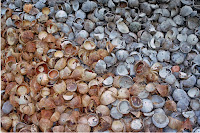
Botanically, the coconut fruit is a drupe, not a true nut. Like other fruits, it has three layers: the exocarp, mesocarp, and endocarp. The exocarp is the glossy outer skin, usually yellow-green to yellow-brown in color. The mesocarp is composed of a fibre, called coir, which has many traditional and commercial uses. Both the exocarp and the mesocarp make up the "husk" of the coconut, while the endocarp makes up the hard coconut "shell".
1.CCSH. Shell Handicraft - Artisanat à base de coque1.CCSHB. Simple containers - Récipients simples
2.CCSHC. Carved without metal - Sculpté sans metal
3.CCSHM. Bronze mounted - Monté sur bronze
4.CCSHG. With gold or silver - Avec Or ou argent
5.CCSHP. Bugbear powder flask - Poires à poudre
2.CCSJ. Shell Jewellery - Bijouterie
1.CCSJE. Earrings - boucles d’oreille
2.CCSJN. Necklace - Collier
3.CCSJO. Other Jewels - Autres bijoux
3.CCSC. Charcoal and fuel - Charbon et combustible
4.CCSF. Shell Freaks - Raretés botaniques
5.CCSO. Other shell uses - Autres usages de la coque

An analysis of Coconut shell composition gave 27.7% pentose,
cellulose 26.6%, lignin 29.4%, water 8%, extraction solvent 4.2%, uronate
anhydrous 3.5%, and ash 0.6%.

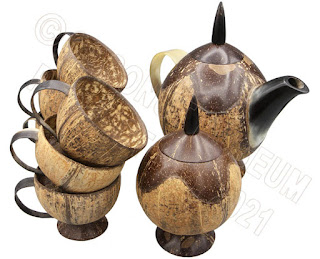
Coconut shell in general is often used as handicrafts, fuels, and raw materials for activated charcoal.





In the process of making charcoal from wood biomass, waste produces smoke, and this smoke can be condensed to a liquid which have interesting chemical and medicinal properties. In the case of coconut, such pyrolysis process produces a dark brown liquid with an average pH value of 3. Forty heigh chemical components were identified at 300°C, the largest component being Acetic acid at 39.98%.